Watch For Free too twisted taboo com curated video streaming. Zero subscription charges on our media destination. Be enthralled by in a great variety of videos unveiled in best resolution, made for prime viewing gurus. With newly added videos, you’ll always receive updates. Witness too twisted taboo com curated streaming in fantastic resolution for a truly enthralling experience. Become a part of our community today to experience subscriber-only media with absolutely no cost to you, no credit card needed. Be happy with constant refreshments and experience a plethora of unique creator content crafted for superior media addicts. You won't want to miss unseen videos—begin instant download! See the very best from too twisted taboo com bespoke user media with amazing visuals and members-only picks.
The meaning of too is besides, also See examples of too used in a sentence. How to use too in a sentence.
The Word Too
To use too and to correctly, use too when you want to say also or excessively, and use to as a preposition for expressing direction, place, or position. “to” is a preposition, while “too” is an adverb. More than is needed or wanted
More than is suitable or enough
Used before an adjective or… The difference between to vs Too is a common spelling error found in writing This guide will teach you how to use them properly.
“to” and “too” sound alike but have very different meanings and usages “to” shows direction and “too” means “also.” learn to use them correctly here. You use too after adding a piece of information or a comment to a statement, in order to emphasize that it is surprising or important. Too and to are similar because they’re homophones (words with the same pronunciation) with similar spellings, but they have very different functions
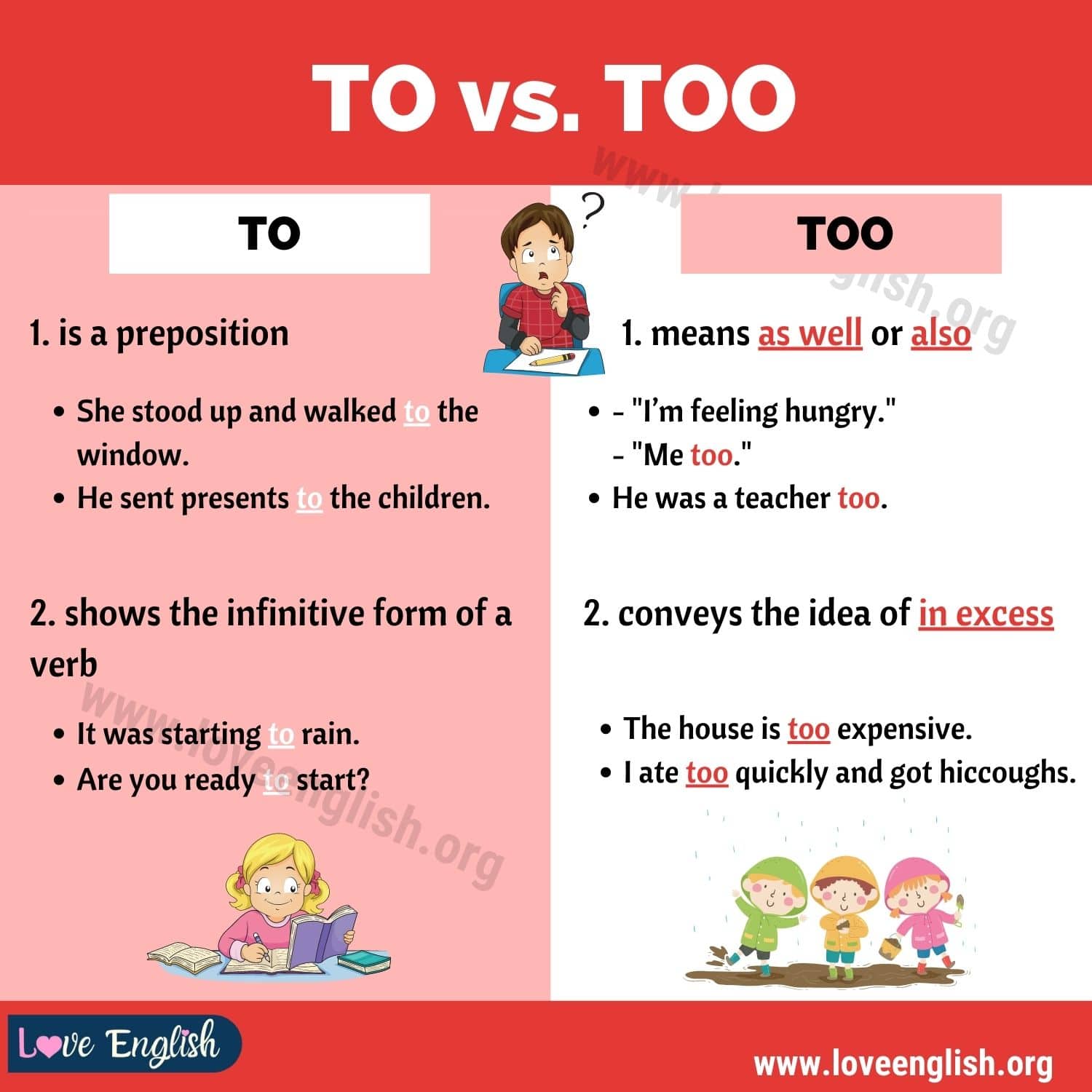
Too is an adverb whereas to is a particle and a preposition
Too’ s most common definitions are “also,” or to show something is done to an excessive degree To as a particle is used to mark the infinitive form of verbs, to give an order. “to” and “too” are pronounced identically, but they have distinct meanings and can even indicate different parts of speech


